
Ritual
How dull would life be without it?


A few years back during what must have been one of my less obnoxious phases, my wife splashed out on an expensive home coffee machine for me. It was something I’d longed dreamed of owning but had always steered clear of because of the cost.
Since then my mornings have taken on a new complexion with a precise and regular routine. After first popping a couple of slices of bread in the toaster, I then become even more insufferable than normal by imagining I’m a barista. In so doing, I follow four steps (and here I am paraphrasing the instruction guide that came with the machine):
I insert the filter holder in the coffee mill outlet, whereupon the machine grinds the beans with a great clamour that wakes up the household.
I remove the filter holder with a flourish and, with the shiny, stainless steel tamper, press the coffee flat.
In a manoeuvre reminiscent of a supply ship docking with the International Space Station, I attach the filter holder to the coffee outlet.
Next, I select my desired beverage (espresso) and press OK to start brewing.
Delivery of the coffee, you will be relieved to know, stops automatically. No silky barista skills required.
In business circles, this is known as a standard operating procedure, or SOP. SOPs are the difference between a great coffee and one that tastes like your two-year-old made it, or a Boeing 747 that becomes successfully airborne versus one that ends up crumpled in the mudflats at the end of the runway.
But our kitchen is not a business circle, and from where I’m standing what I’m up to is at least as much ritual as it is SOP.
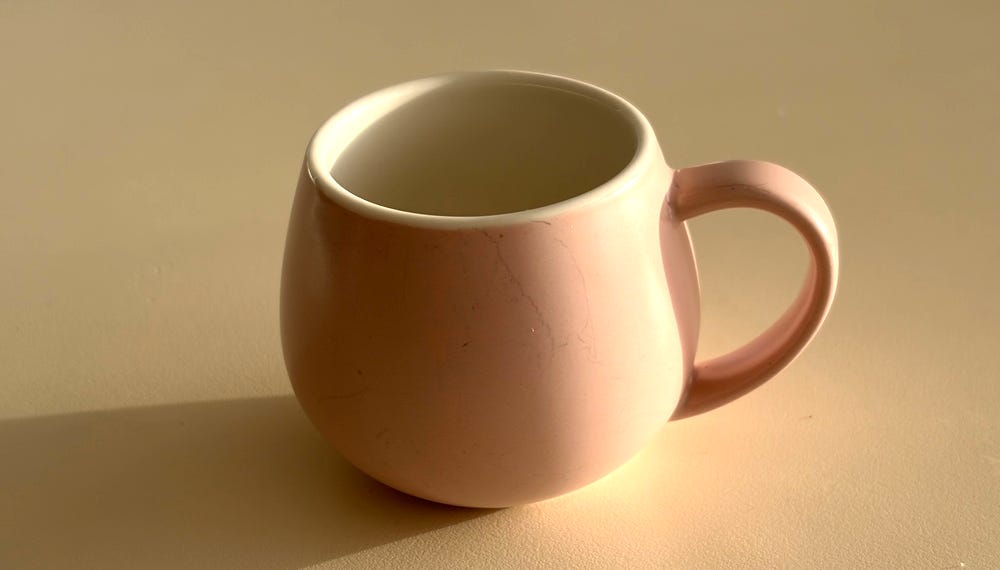
I love the sound of the grinder. I love the chugging of the machine as it prepares to push hot water through the coffee, and the splashing of the brew as it falls into the cup. I love the heft of the filter holder and the feel of the carefully machined cross hatching at the business end of its handle. I love the oblate cup that holds my espresso - its perfect, slightly pregnant dimensions, its retro-pastel colouring. I love the deep aroma that rises like a genial spirit from the cup with its assurance of a happy day ahead.
That said, this is distinct from the kind of religious ritual I grew up with. The heady incense on certain feast days, the tinkling of the bell at key points during Mass, the priest’s back turned to parishioners as he intoned in Latin - these served no practical function, yielding neither coffee nor a more accurate version of the one true faith. Yet when the Catholic Church ended its adherence to the Latin Mass in the late 1960s, some believers were horrified, and to this day a small handful contend that the new, vernacular version - officially called Novus Ordo - offends God.
Surprisingly, at least to me, ritual is a latecomer to English, having made its way unchanged from France in the mid-1500s. French drew it from the Latin ritualis. For its first 100 years it was an adjective, but around 1640 it began being used as a noun, and 200 years later some clever person coined ritualistic.
It’s also a kissing cousin of rite, a word English did possess from the early 1400s, and you’d have to say that if you’ve got that word, you can probably squeak by without ritual on most occasions. The phrase rite of passage was cooked up in 1909 by French anthropologist Arnold van Gennep to describe ceremonies in which an individual left one group to join another. His book, Les Rites de Passage, was a major influence on writer Joseph Campbell, who drew on it heavily for his seminal book The Hero with a Thousand Faces.
One measure of Campbell’s influence - both trivial and profound in my view - is that George Lucas credited him for informing the sequels of the original Star Wars story. Other films and film series whose writers have acknowledged a debt to Campbell include The Lion King, The Matrix, Batman and Indiana Jones.
From this, I conclude that while ritual may play a central role in religion, it’s not a solely religious phenomenon. As further evidence, I present your habit of setting the table when people come for dinner, putting on makeup before going out in public, saying “excuse me” when you bump into someone, shaking hands when introduced to your friend’s friend, and posting photos on social media that present a suitably curated version of your life to the world. All could be dispensed with - and are dispensed with by many - without the world falling apart. Yet here we all are with our own rituals without which the foundations of our personal world would suddenly feel just a little shaky.
One ritual I still miss nearly 40 years after putting a reluctant stop to it is rolling a cigarette. Like all the best rituals, this one required interrupting whatever else you had going on and giving it your full attention. It also took practice - the dexterity needed to avoid a tobbacoey disaster was worthy of a jeweller. And the finished product was always a thing to behold: a miniature, hand-crafted joy that held the imminent promise of quiet bliss.

Anyone interested in mastering this life-shortening craft could do worse than view this WikiHow page. But I have to warn you, like most videos that illustrate how to do something, this one makes it look like the simplest thing in the world. It’s not. In fact, it’s fiendishly difficult until, suddenly, you nail it, whereupon it does become - and only then becomes - stunningly easy.
My advice: get a coffee machine instead. Unlike smoking - or religion for that matter - it may save you money in the long run and is way, way less likely to mess you up.
Bits and specious
A couple of years back in an article on grumpy, I mentioned an experiment called the “bouba kiki test” designed to see whether people associate different sounds with different kinds of shapes. It turns out we do, and now it turns out that we may not be the only ones.
My latest favourite word: Nerdgas; to bitch and moan about science or continuity screw ups in science fiction. Not to be confused with nerdgasm, the thrill of excitement you feel in response to something relating to a subject in which you have an obsessive interest. Not to be confused with urgasm (my own creation, I’m proud to say), the original orgasm of which all subsequent orgasms are but a pale shadow.
At long last, as I approach the age at which Walt Whitman died, I think I’m finally starting to appreciate the old man. Hat tip to Henry Oliver who highlighted the stop-you-in-your-tracks line “Where through the carnage I moved with a callous composure” from Whitman’s Civil War poem In Midnight Sleep.
Quote of the week
Some people say there is a God. Others say there is no God. The truth probably lies somewhere in-between.
William Butler Yeats
The piece is easy to lift from because the insight is simple and portable: “without which the foundations of our personal world would suddenly feel just a little shaky.”